The numbers don’t Lie – PART 1 – Submission data

Written by Katie Bignell
This article is the continuation of a presentation that I gave at Sunrise Film Festival earlier in the year. It’s part 1 of a 2-parter exploring data from submissions to a select few festivals. (Part 2 will look at selection data from the film festivals in question.) If you saw the OG presentation, then you’ll know it was packed with memes and gifs. I don’t have as much luxury in the written form, but check out part 2 for mentions of horses (IYKYK).
As filmmakers it can breed frustration when you receive that painful stilted rejection email about “receiving a record number of submissions”, and for festivals it’s exasperating having to send them. So what if we used data to help both sides understand each other a little better? I decided to collect and explore data from film festivals to see what we could learn about their submission processes - from the number of submissions compared with acceptances, to submission numbers broken down by format, genre, runtime, and production location. In the end, I reached out and received data from 9 different festivals.
I was also intrigued by where submissions come from and how does this translate into film festival selections? Does the cost of the festival or the location make a difference to the number of submissions?
What I do have to point out is that not every festival could provide data for each question so we leaned on the results being an average reading. Whilst this was a presentation to pique the interest of filmmakers, I do hope that it makes a festival want to harness their own responses too.
participating festivals:
The following festivals provided their insights and data, for which I am hugely grateful:
Sunrise Film Festival (UK, Lowestoft - 6 years) // BIFA
Indy Shorts Film Festival (USA, Indiana - 10 years) // OSCAR+BAFTA+GOYA
Oak Cliff Film Festival (USA, Texas - 13 years)
Leuven International Short Film Festival (Europe, Belgium - 32 years) // OSCAR+BAFTA+EFA+GOYA
IN THE PALACE International Short Film Festival (Europe, Bulgaria - 24 years) // OSCAR+GOYA
Bref International Short Film Festival (Europe, Italy - 3 years)
FILMFEST DRESDEN - International Short Film Festival (Europe, Germany - 37 years)
Vilnius Short Film Festival (Europe, Lithuania - 20 years) // OSCAR+EFA
Tampere Film Festival (Europe, Finland - 57 years) // OSCAR+BAFTA+EFA+GOYA
the supply and demand dilemma
submission versus selection data…
I asked film festivals to send the number of submissions that they received, as well as the number of selections they made…
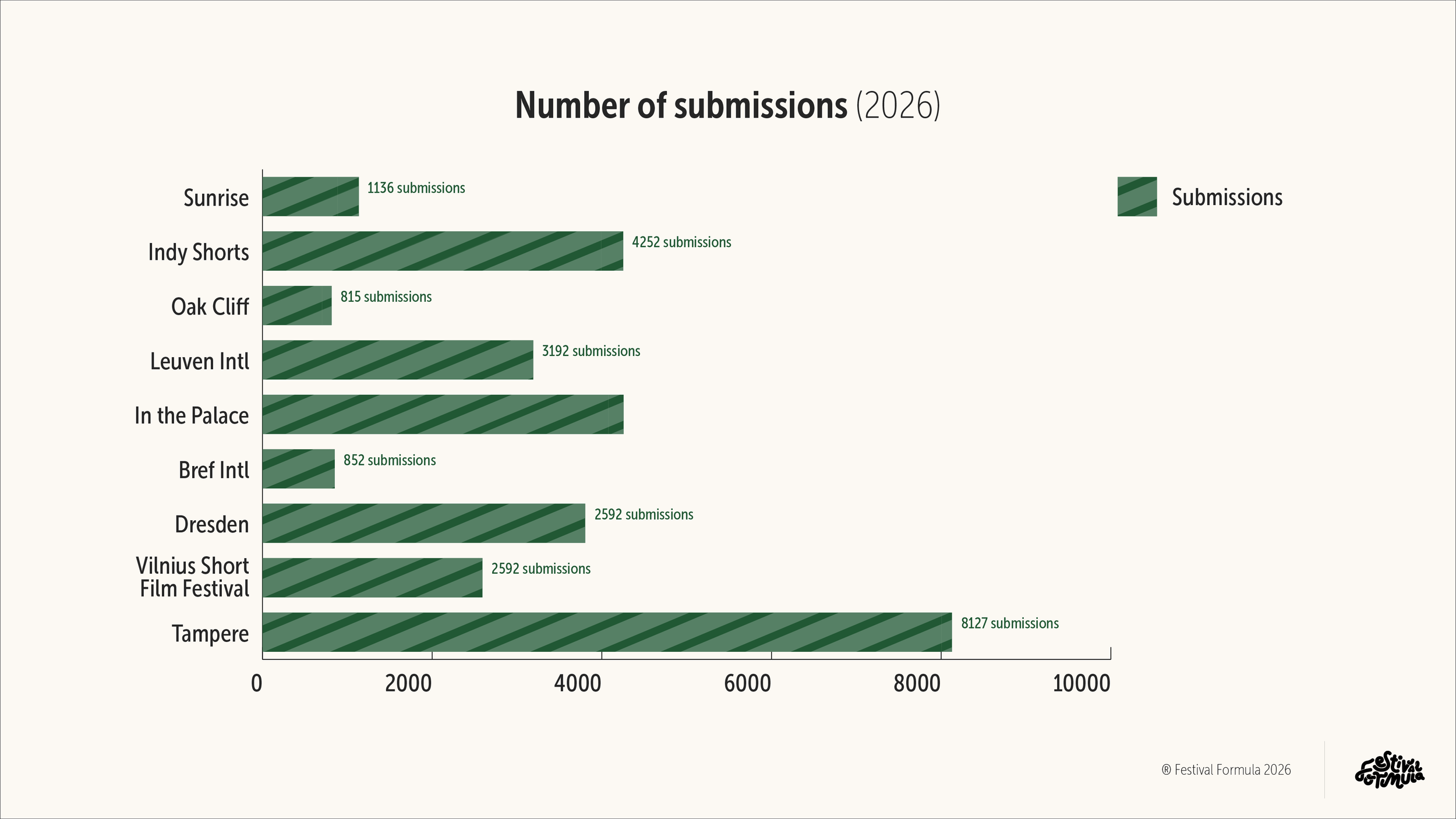
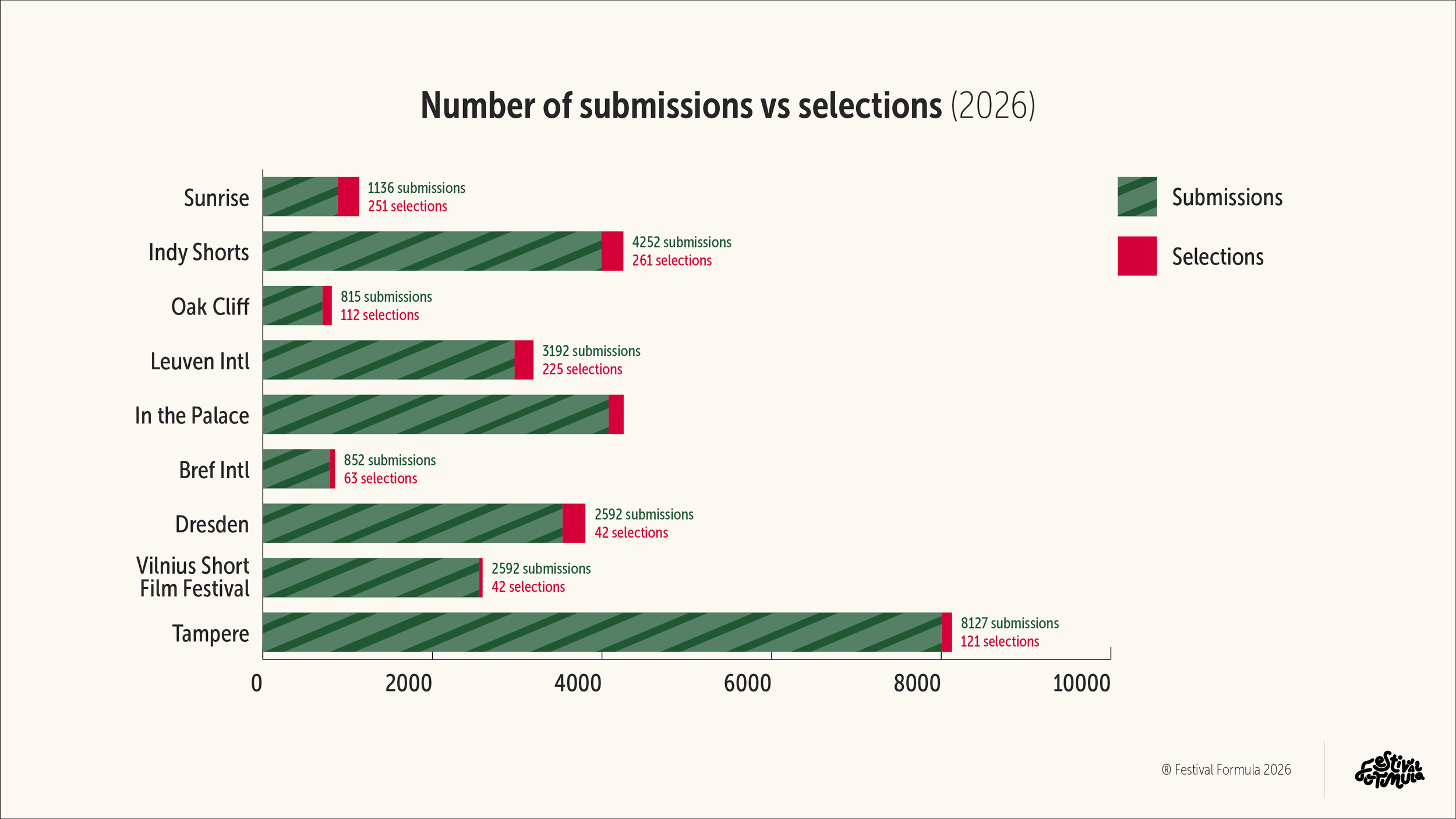
For the submission data - as a strategist I look at these numbers and they make sense. Long-running festivals, and/or those with industry kudos (ie. Oscar, BAFTA, BIFA, European Film Award or GOYA) receive substantially more submissions compared to the less industry-known or younger festivals. Everyone wants their film at Tampere, Dresden, or Indy Shorts.
From a filmmaker’s perspective it may seem like each festival is getting a lot of submissions, which is true to a degree. The simple truth of festivals is that a festival will receive more submissions than they can screen. It is important for filmmakers to research these numbers before applying to a festival. Researching a festival’s submission versus selection numbers can prepare you more realistically for what’s to come on your festival acceptance journey.
And some festivals just won’t be worth submitting to based on numbers alone.
Here’s everything in one graph - it’s harder to see the selection numbers here, which is why I shared the separate ones above. But this gives you more of an overview of the sheer number of film submissions versus selections.
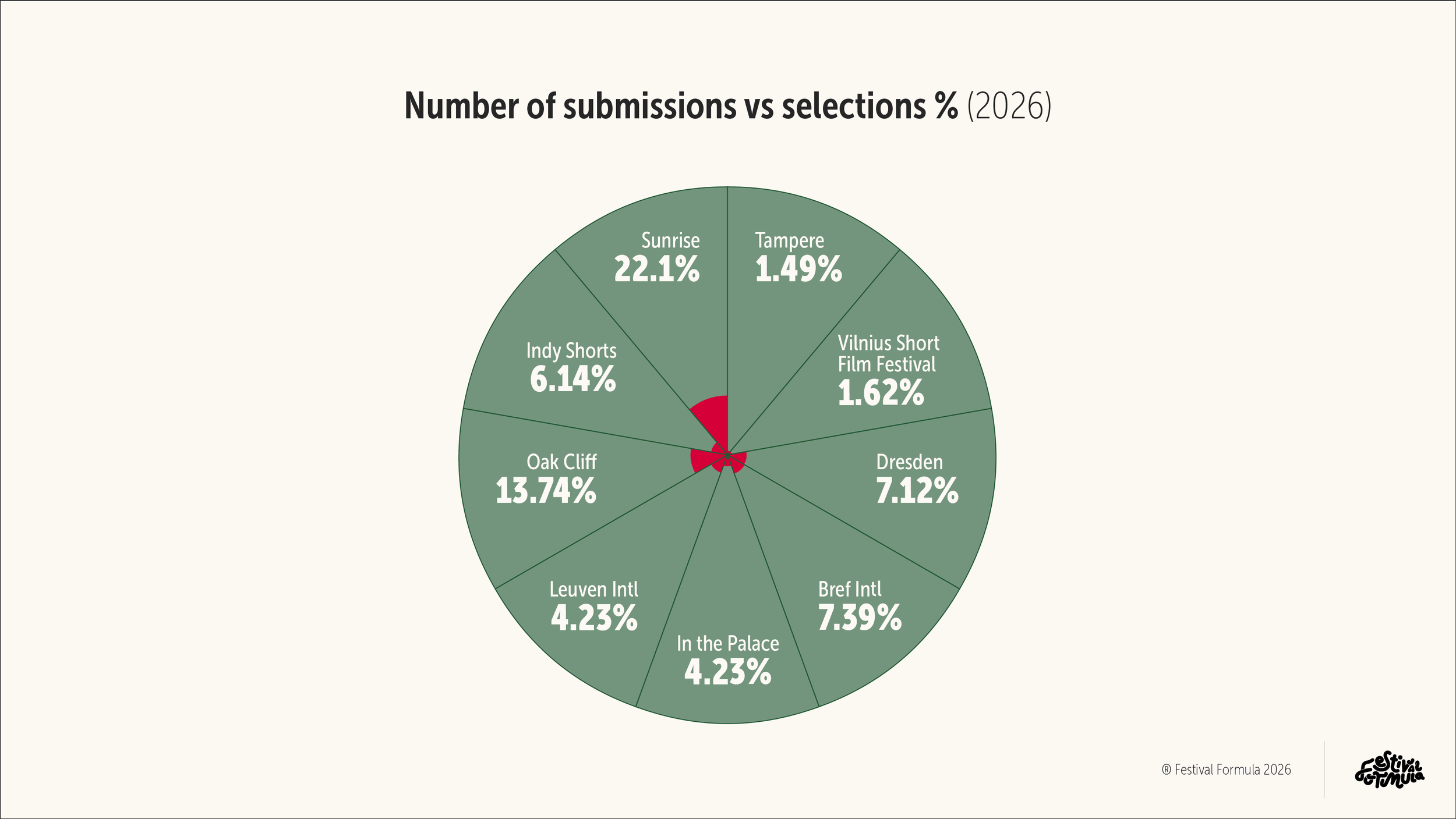
Tampere is the most popular in terms of submissions, but had to whittle their number of films down to just 121, that’s 1.49% of all the films submitted. I also think that these numbers are a reminder to filmmakers that the odds aren’t always in their favour, which makes putting together a strong festival strategy even more important (unless you like throwing away money.)
It’s also a reminder that smaller film festivals can be more worth your time and attention than the big guys. Oak Cliff and Sunrise film festivals have a much more reasonable selection rate compared to the number of submissions.
But this is the tip of the iceberg in terms of film festival submission and selection data. I wanted to get my hands even dirtier to find out the breakdown of the submissions versus the selections by format.
what’s the most popular format with filmmakers?
submission data broken down by format
I asked film festivals to break down their submissions by format (ie. Live action narrative, animation, documentary, experimental/other, hybrid)
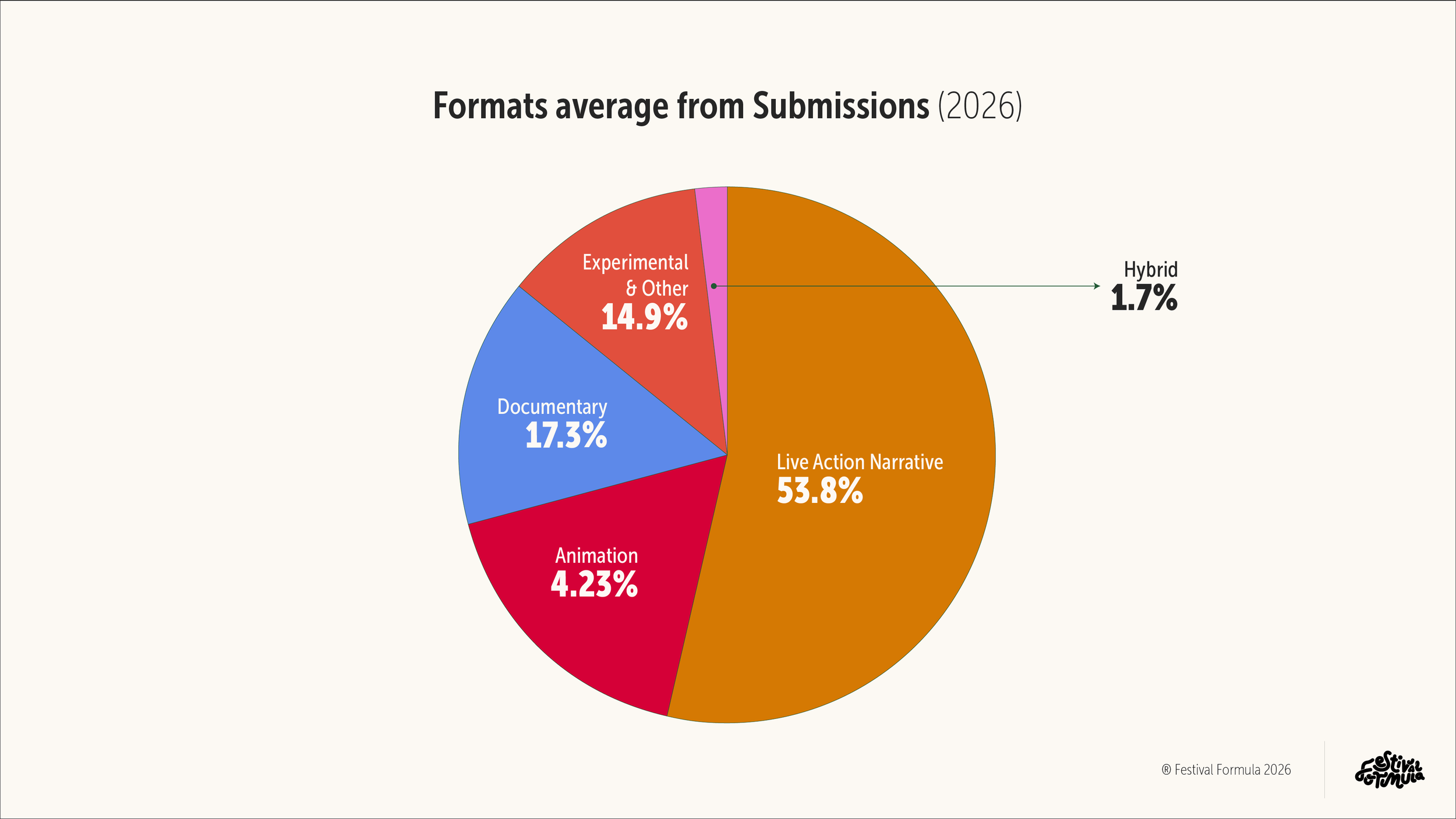
Pie Chart showing a breakdown of film submissions to festivals by format. Live action narrative is at 53.8%, animation is 12.3%, documentary at 17.3%, experimental/other is 14.9% and hybrid is 1.7%
Which film formats do programmers receive most of, and how is this reflected in the selections?
I’m unsurprised that live action narrative leads the way. As a strategist we’re always being told by programmers that they need more animation and documentaries (sub 15 mins as a side note). So what if we now break the submissions down by genre?
The Spectrum of Flavours
submissions broken down by genre
I asked the film festivals to break down their submissions by genre ( ie. Action, comedy, crime, drama, horror, romance, sci-fi/fantasy, thriller, western)
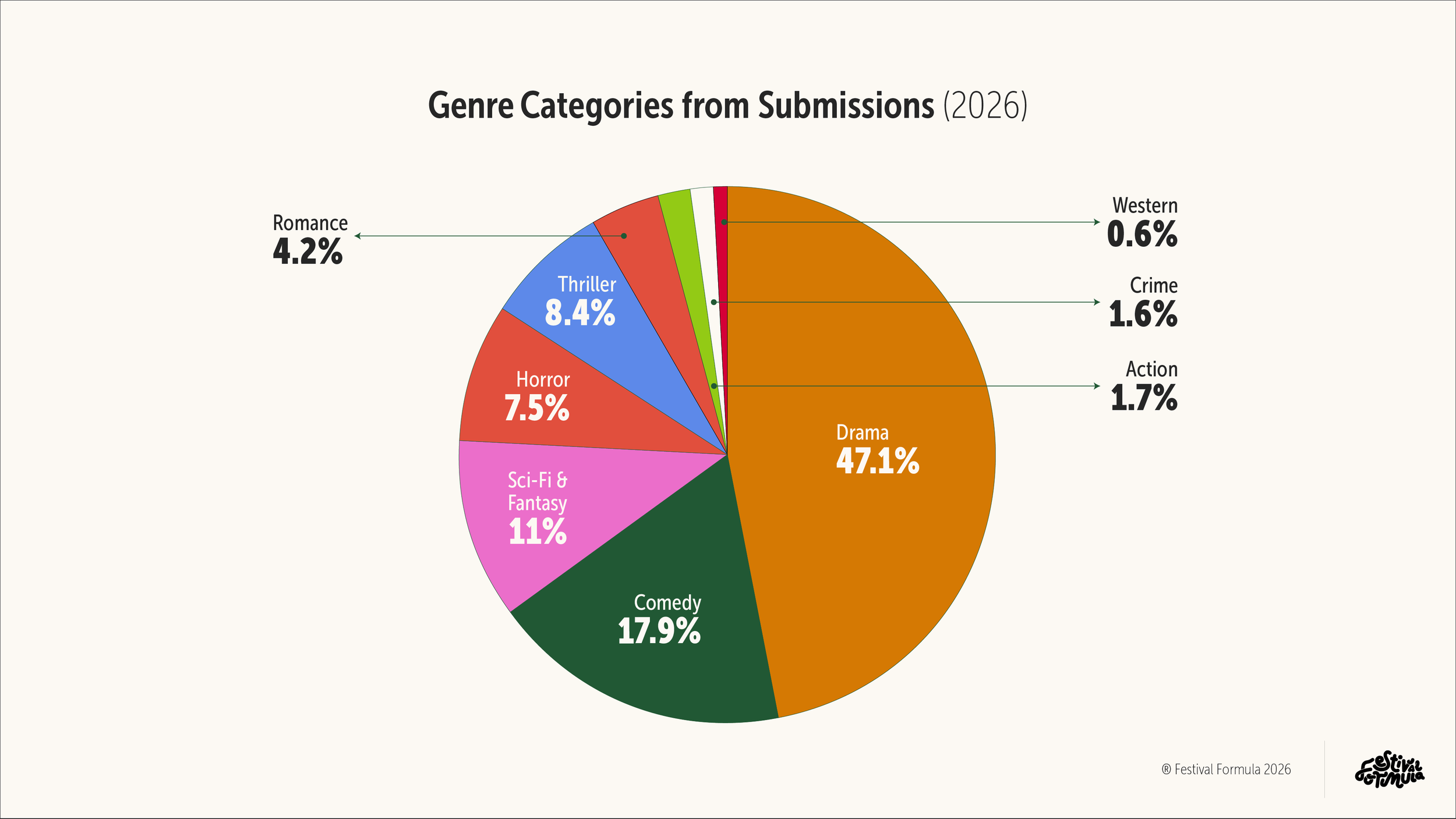
Film submissions to festivals broken down in a pie chart by genre categories. Drama is 47.1%, horror 7.5%, Sci-fi/fantasy is 11%, thriller is 8.4%, western is 0.6%, action is 1.7%, comedy is 17.9%, and crime is 1.6%
What I found interesting at this point was that some festivals couldn’t provide as detailed information as they would like.
Several factors are at play here, but it mainly comes down to the submission platform they are utilising:
FilmFreeway utilises multiple genre data points either with tick boxes or with free fields
Shortfilmdepot had a more limited choice and is confined to the tick boxes offered up
We’ve factored in a margin for hybrid-genre films, asking our contributing festivals to lead with the main defining genre.
There’s no real groundbreaking news here that drama (47.1%) is the leader with most submissions, and comedy (17.9%) is close behind. The appearance of thrillers (8.4%) was a pleasant surprise with crime (1.8%) and western (0.6%) still represented but very minimally.
how long do you need to tell a story?
average run time of film submissions
I asked film festivals to break down their submissions by duration (ie. 1-10mins, 10:01-15 mins, 15:01-20 mins, 20:01-30 mins, 30:01+)
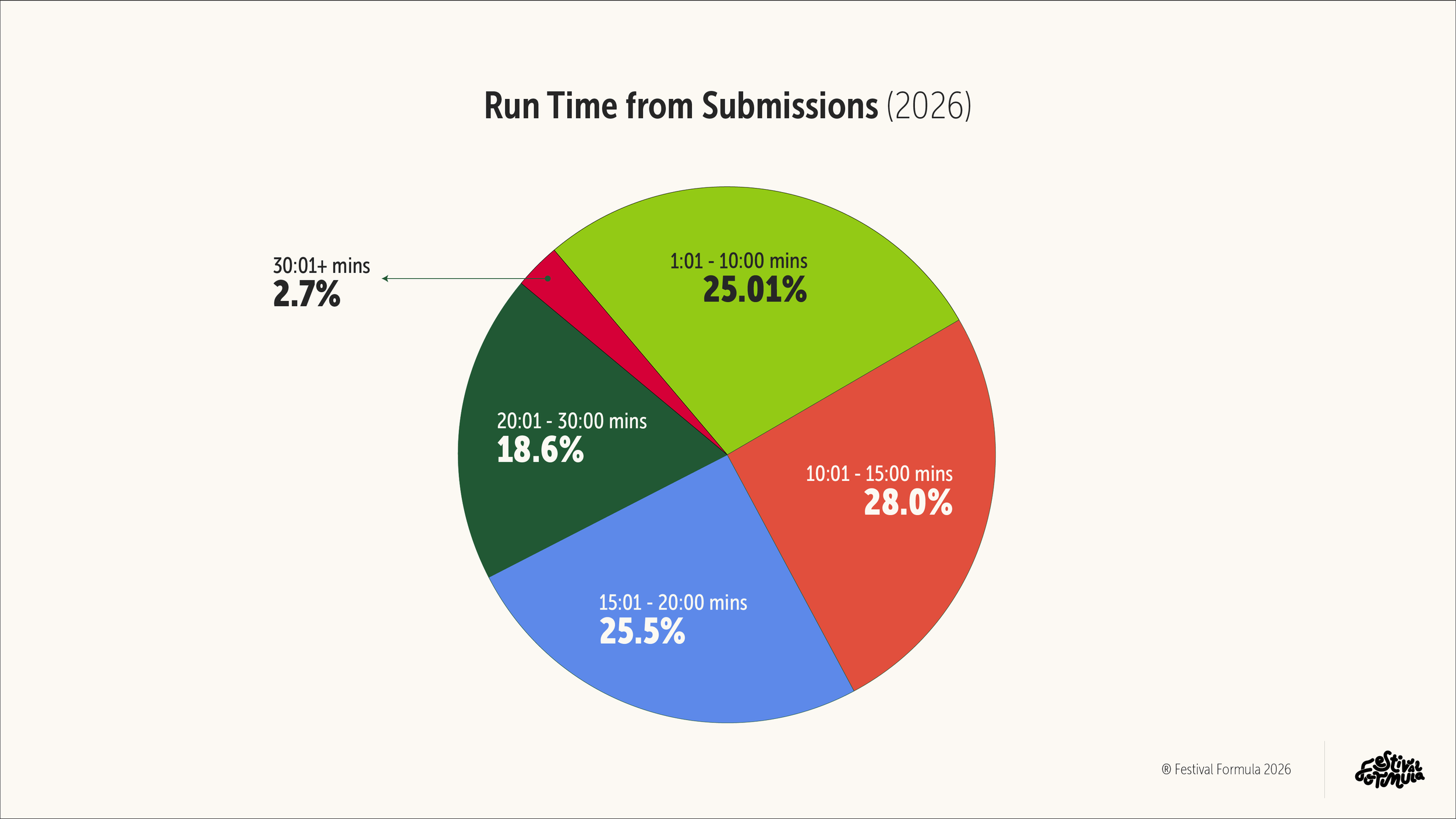
One factor to be aware of here is that not all the festivals who provided their info accepted films over 30 mins, so whilst it is the smaller wedge of the pie, it’s also to note that we are restricted to the festivals we spoke to.
As a strategist of over 23 years, I’ve seen peaks and troughs when it comes to run times. In the era of the early 2000s short films did often run longer (Andrea Arnold’s “Wasp” at 26mins from 2003 and Martin McDonagh’s “Six Shooter” at 27mins from 2004 are two fine examples). Then in the mid-2000s we saw a drastic turn of 15mins (approx) and under being the norm. (Notable films include Daniel Mulloy’s “Antonio’s Breakfast” at 16mins, and one of my personal favourite short films, Simon Ellis’ “Soft” coming in at 14mins both from 2006.) As we’ve wandered through the years, it’s a mixed bag but as a company we’ve seen in the past year the average short film sent to us to consider for our Slate runs at 12 mins.
As recently noted by my colleague Mark in his blog about run time, there is no magic run time. But if we look at the literal breakdown from these festivals then up to 20 minutes leads when it comes to submission run times. With 1-10 mins and 15:01-20 mins holding approx 25% each, it’s the 10:01-15 min run times that lead the charge with 28%.
near, far – wherever you are
submissions by location
I asked film festivals to break down their submissions by location (ie. Local, national, international)
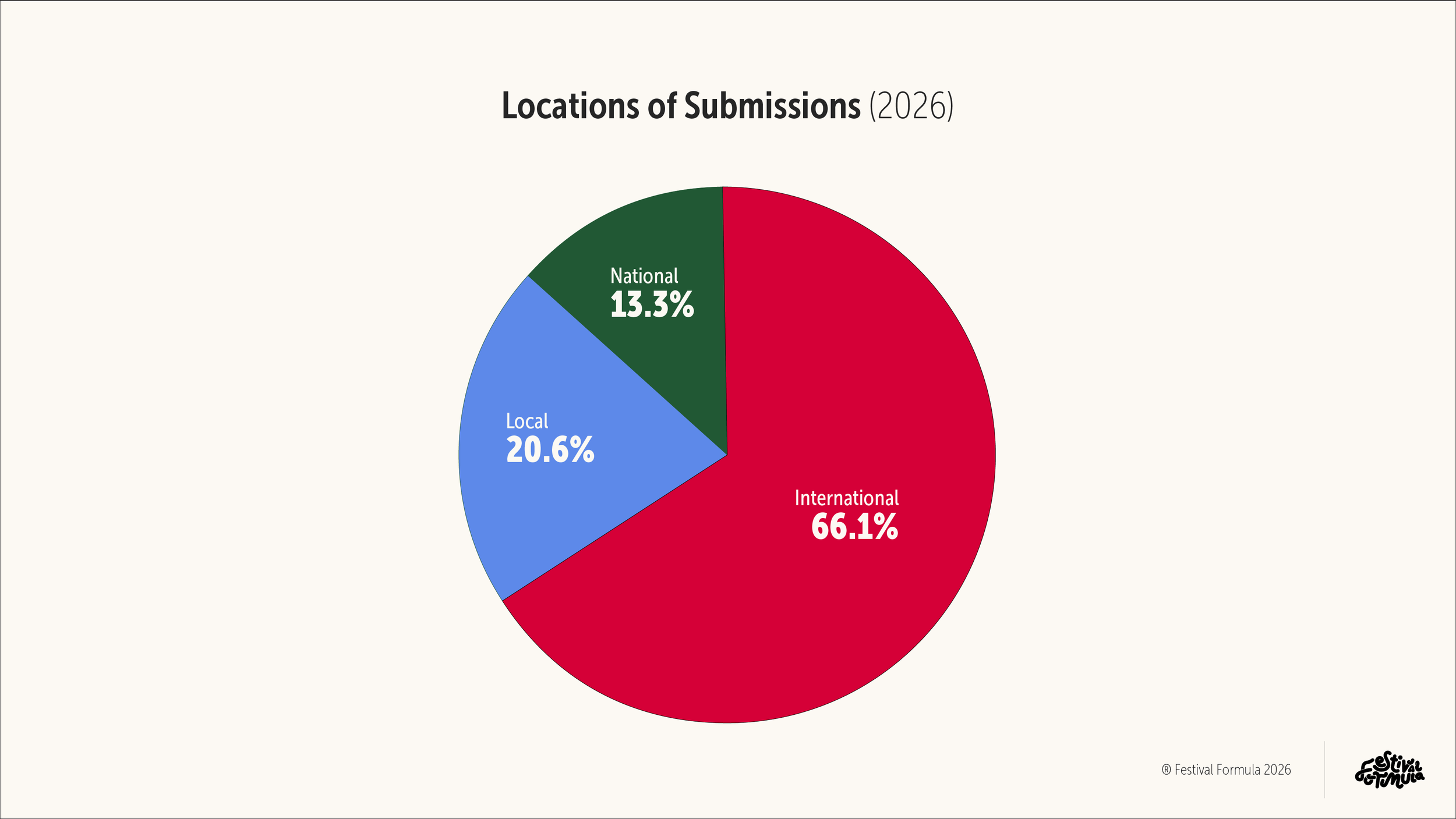
One of the frustrations we hear from filmmakers, especially those looking to festivals in their own territory, is how they feel that homegrown talent is often overlooked.
In some circumstances we’ve seen filmmakers vent that the International filmmakers are left by the wayside to give more spotlight to national or local productions.
For this question we also had festivals who didn’t have all the info to hand, especially for local submissions: This could either be from the data they acquired at the point of submission or if a festival had a separate category for local (or regional) productions.
International submissions are clearly outnumbering other types here, but you also have to consider how festivals are recording the information: for example, a German filmmaker submitting to a European category could be considered local or national. But, from a general standpoint, a majority of films submitted will be outside the country of production.
So this is the end of part 1, we have taken a look at submissions to our 9 film festivals by various categories, genre, time, and location. What have we noticed? That film festivals receive so many more films than they programme, that the majority of submissions tend to be dramas, they’re under 20-minutes long, they’re live-action, and they’re often international submissions.
And as for the less-seen submissions, they’re sent to less-established film festivals, are hybrid format, action or crime genre-films, and they run over 30 minutes long.